Magnetization measurements by the inductive method under ultrahigh magnetic fields above 150 T
One popular topic in ultrahigh magnetic–field research above 100 T is field-induced phase
transitions in antiferromagnets. The primary probe is magnetization, although employing the
induction method using a self-compensated pickup coil in ultrahigh fields is challenging due to
severe electromagnetic noise from large discharge currents and the huge induced voltages arising
from the rapid temporal variation of the field. A particular diffiulty is subtracting the
background, which is much larger than the sample's intrinsic magnetization signal. Without an
accurate measurement of the background component, reliable magnetization curves cannot be
obtained. Consequently, with existing techniques, high-precision magnetization measurements
above 130 T have remained difficult.
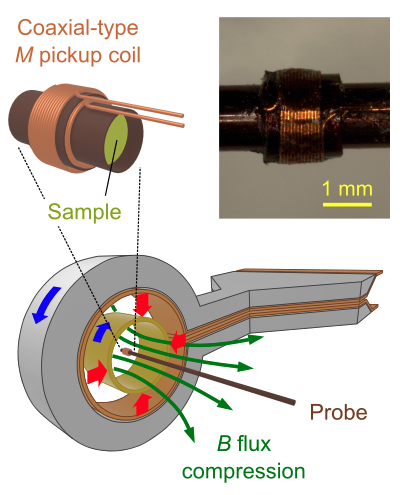
Here, we redesigned the pickup coil from the ground up. Instead of the conventional parallel-type geometry, we devised a coaxial pickup-coil configuration [A] and optimized the coil size and winding numbers. After three years of iterative development, we ultimately achieved precision magnetization measurements up to 150 T using a single-turn coil system [B]. We then applied this technique to an electromagnetic flux-compression system and successfully detected magnetic phase transitions in the 300–400 T range [C]. These advances open the door to the exploration of ultrahigh-field-induced phase transitions in many antiferromagnets that were previously inaccessible.
[B] M. Gen et al., Phys. Rev. B 101, 054434 (2020). (Original paper [3])
[C] M. Gen et al., Proc. Natl. Acad. Sci. U.S.A. 120, e2302756120 (2023). (Original paper [22])
Here, we redesigned the pickup coil from the ground up. Instead of the conventional parallel-type geometry, we devised a coaxial pickup-coil configuration [A] and optimized the coil size and winding numbers. After three years of iterative development, we ultimately achieved precision magnetization measurements up to 150 T using a single-turn coil system [B]. We then applied this technique to an electromagnetic flux-compression system and successfully detected magnetic phase transitions in the 300–400 T range [C]. These advances open the door to the exploration of ultrahigh-field-induced phase transitions in many antiferromagnets that were previously inaccessible.
References
[A] M. Gen et al., J. Magn. Magn. Mater. 473, 387 (2019). (Original paper [1])[B] M. Gen et al., Phys. Rev. B 101, 054434 (2020). (Original paper [3])
[C] M. Gen et al., Proc. Natl. Acad. Sci. U.S.A. 120, e2302756120 (2023). (Original paper [22])